How Much Magnification to See Saturn: Rings, Cassini Division and Moons
By Indrek Eenmaa 7 min read Updated November 26, 2026
The numbers to remember
- Rings become recognizable near 25x to 30x and clear at 50x to 100x.
- The Cassini Division is about 0.8 arcsecond wide at opposition: plan on 150x+ and 6 inches.
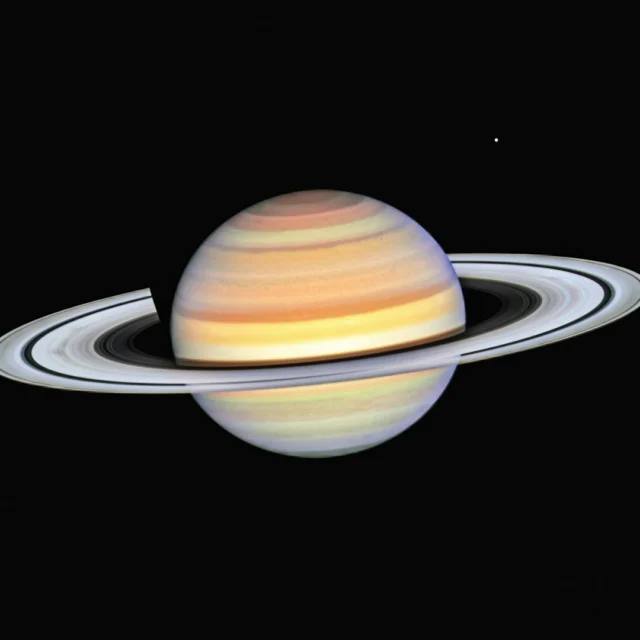
- Saturn's disk spans 14.5 to 19.9 arcseconds; the rings about 2.3 times that.
- In late 2026 the rings tilt only about 6 to 9 degrees toward Earth.
- Titan (magnitude 8.2) shows in any telescope; Enceladus (11.6) needs 8 inches.
- Saturn reached opposition on October 4, 2026, and is lost in evening twilight by late March 2027.
- Steady air matters more than magnification past about 200x.
In this guide
Saturn’s rings become recognizable at about 25x to 30x and are clearly separate from the planet at 50x to 100x. Any telescope, even a 70 mm refractor with its kit eyepieces, can show them. The finer detail takes more: the Cassini Division, the dark gap between the two bright rings, is under 1 arcsecond wide, so plan on about 150x or more, roughly 6 inches of aperture and a steady night.
One thing has changed recently. Earth passed through the plane of Saturn’s rings in March 2025, and in late 2026 the rings are tilted only about 6 to 9 degrees toward us. They look like a thin bright line through the planet rather than the wide oval in most photos. They open a little more each year until 2032.
How big Saturn looks, in numbers
NASA’s Saturn fact sheet gives the planet’s apparent diameter from Earth as 14.5 to 19.9 arcseconds, depending on where both planets are in their orbits. At the October 4, 2026 opposition, JPL Horizons puts the disk at 19.7 arcseconds. NASA’s ring fact sheet gives the A ring’s outer edge at 136,780 km from Saturn’s center and the planet’s equatorial radius as 60,268 km, so the bright ring system spans about 2.27 times the planet’s width: roughly 45 arcseconds at opposition.
Magnification turns those tiny angles into something your eye can read. At 40x, the ring system appears 30 arcminutes wide, the same as the full Moon looks to the naked eye. At 100x it looks two and a half times the width of the naked-eye Moon. That is why even modest power works well on Saturn’s overall shape: the system is small, but it is bright and high in contrast.
| Feature | True size at 2026 opposition | Apparent size at 50x | Apparent size at 150x |
|---|---|---|---|
| Ring system (A ring, edge to edge) | About 45″ | About 37′ | About 1.9° |
| Saturn’s globe | 19.7″ | About 16′ | About 49′ |
| Gap between globe and B ring, at each side | About 5″ | About 4′ | About 13′ |
| Cassini Division, at the ring ends | About 0.8″ | About 0.7′ | About 2′ |
Sizes are worked out from NASA’s ring radii and JPL’s disk size. Saturn shrinks as Earth moves away after opposition: by early 2027 the disk is closer to 17 arcseconds, so all features are about 12 percent smaller.
What you see at each magnification
| Magnification | What Saturn looks like |
|---|---|
| 10x to 20x | A bright star that looks slightly elongated, if at all |
| 25x to 40x | A small disk with “ears” or a line through it; the ring shape becomes recognizable |
| 50x to 100x | Rings clearly detached from the globe, dark gap on each side; Titan nearby |
| 100x to 150x | Often the rings’ shadow on the globe or the globe’s shadow on the rings, depending on geometry; faint belts on larger scopes |
| 150x to 250x | Cassini Division at the ring ends in 6 inch and larger scopes on steady nights; more cloud banding |
| Above 250x | Rarely better; Tele Vue notes the atmosphere usually limits planetary viewing to about 300x |
The practical sweet spot for most telescopes is 100x to 200x. Start lower, focus carefully on Saturn itself, and step up one eyepiece at a time. If the image looks bigger but softer, go back down. Our guide to telescope magnification explains why seeing, not the eyepiece, sets the ceiling on most nights.
To find the eyepiece for a target power, divide your telescope’s focal length by that power. For 150x in a 1200 mm Dobsonian you need an 8 mm eyepiece; in a 650 mm reflector a 4.3 mm, or an 8.6 mm with a 2x Barlow. The eyepiece calculator does this for any scope, and our comparison of the 25mm vs 10mm telescope eyepiece shows what typical kit eyepieces deliver.
Rings, Cassini Division and cloud belts by aperture
Magnification makes things bigger; aperture decides how fine a detail exists to magnify. The Dawes limit formula (4.56 arcseconds divided by aperture in inches) gives a rough guide to which Saturn features each size can resolve:
| Aperture | Dawes limit | Rings | Cassini Division (about 0.8″) | Saturn’s moons within reach |
|---|---|---|---|---|
| 70 mm (2.8 in) | 1.66″ | Clear at 50x to 100x | Below the resolution limit | Titan, possibly Rhea |
| 114 to 130 mm (4.5 to 5.1 in) | 1.0″ to 0.9″ | Sharp at 100x to 150x | Borderline, needs very steady air | Titan, Rhea, often Tethys and Dione |
| 150 mm (6 in) | 0.77″ | Sharp at 150x and up | At the ring ends on good nights | Titan, Rhea, Tethys, Dione, Iapetus near its brightest |
| 203 mm (8 in) | 0.57″ | Detailed at 150x to 250x | Visible in decent seeing | Adds Enceladus near its widest separation |
Celestron, for example, says its 6 inch NexStar 6SE shows “Cassini’s Division in Saturn’s rings.” The Dawes limit puts the division right at the edge of what 6 inches can split, so that claim fits a steady night with the rings well open. In 2026 and 2027 the low ring tilt makes the division much harder, because it is foreshortened everywhere except near the ends of the rings.
Aperture also brings out Saturn’s globe. Belts on Saturn are lower in contrast than Jupiter’s, and the brighter equatorial zone and darker polar region show better with 6 inches or more. How a 6, 8, 10 or 12 inch Dobsonian handles planets and deep-sky objects is covered in what you can see with a 6, 8, 10 and 12 inch Dobsonian.
Saturn’s moons and what you need for each
Saturn’s moons look like faint stars lined up roughly along the ring plane. Magnitudes below are from JPL Horizons for the October 4, 2026 opposition; they fade by a few tenths in the months after.
| Moon | Magnitude (Oct 2026) | Typical minimum aperture |
|---|---|---|
| Titan | 8.2 | Any telescope; 15×70 binoculars on a tripod |
| Rhea | 9.6 | 60 to 80 mm in a dark sky |
| Tethys | 10.1 | About 100 mm |
| Dione | 10.3 | About 100 mm |
| Iapetus | About 10 to 12, varies | About 100 mm at its brightest, more at its faintest |
| Enceladus | 11.6 | About 8 inches, at its widest separation |
The aperture column compares each magnitude with Celestron’s published limiting magnitudes, for example 11.7 for its 70 mm refractors and 12.8 for its 114 mm reflector, then allows for Saturn’s glare, which hides moons that sit close to the planet. Iapetus is the odd one: NASA describes its leading hemisphere as “as dark as coal,” while the trailing hemisphere reflects about ten times more light, so Iapetus is much brighter on one side of its orbit than the other. The 17th-century astronomer Cassini could only see it on one side of Saturn for that reason.
Can you see Saturn’s rings with binoculars?
Not as separate rings. At 10x, the 45 arcsecond ring system appears about 7.5 arcminutes wide, so on a tripod 10×50 binoculars may show Saturn as slightly oval rather than round. At 15x it is about 11 arcminutes, and the elongation is easier to notice. Neither shows a gap between the ring and the planet; that needs roughly 25x or more and a steadier mount than hands. With the rings nearly edge-on in 2026 the effect is subtler still. Binoculars do pick up Titan, and our comparison of 10×50 vs 15×70 binoculars covers which pair suits planets better.
Ring tilt from 2026 to 2032
The look of the rings changes far more over the years than any eyepiece changes it. Ephemeris data from the PDS Rings Node, compiled by Michigan State University’s Abrams Planetarium, give the ring opening as seen from Earth:
| Date | Ring tilt toward Earth | What it looks like |
|---|---|---|
| March 23, 2025 | 0° (edge-on) | Rings invisible; Saturn was too near the Sun to observe |
| July 2026 | 9.2° (local maximum) | Thin, bright ellipse |
| December 2026 | 6.1° (local minimum) | Narrow line with “ears” |
| August 2027 | 14.4° | Noticeably open; Cassini Division easier |
| 2028 to 2029 | About 12° to 23° | Opening wider each year |
| May 2032 | 26.9° (maximum) | Fully open, the classic view |
| October 2038 | 0° (edge-on again) | Rings vanish to a line; three crossings in 2038 to 2039 |
Thin rings have their own appeal: the moons line up neatly along them, and the shadow of the rings on the globe is easy to see as a dark line.
When Saturn is well placed in 2026 and 2027
NASA’s October 2026 skywatching guide gives Saturn’s opposition as October 4, 2026, when Earth passes between Saturn and the Sun. Around opposition Saturn rises at sunset, is up all night and looks its largest and brightest. JPL Horizons puts it in Cetus, near the border with Pisces, through the 2026 evening season.
From November through January it is best placed in the evening, highest in the south a few hours after sunset. By February 2027 it is low in the west at dusk, and Horizons shows it passing behind the Sun in early April 2027 before returning to the morning sky. NASA’s fact sheet gives Saturn’s synodic period as 378 days, so each opposition comes about two weeks later in the calendar than the last; the 2027 opposition falls in mid-October.
For the sharpest view, observe when Saturn is highest, because you look through the least air. Let the telescope cool to outdoor temperature before you push the power if it lives indoors, and do not observe over a roof or driveway that is releasing the day’s heat. On a steady night, those habits do more for the Cassini Division than another eyepiece.
Questions people ask
Can you see Saturn's rings with a 70mm telescope?
Yes. A 70 mm refractor at 50x to 100x shows the rings clearly separated from the globe, and Celestron's 70 mm AstroMaster ships with a 10 mm eyepiece giving 90x. Titan is easy too, since Celestron rates these scopes to magnitude 11.7. What a 70 mm will not show reliably is the Cassini Division, which is narrower than its 1.66 arcsecond Dawes limit, or cloud bands on the globe beyond a faint hint.
What is the best eyepiece for viewing Saturn?
The one that gives your telescope about 100x to 200x, then a step higher for very steady nights. That is a 6 mm to 12 mm eyepiece in most 650 mm to 1200 mm scopes. Divide your focal length by the power you want to get the eyepiece focal length. Tele Vue suggests having something that reaches at least 150x for planets.
Can you see Saturn's rings with binoculars?
Not as rings. At 10x the ring system appears about 7.5 arcminutes wide, a quarter of the naked-eye Moon, so steadily mounted 10x50 binoculars may show Saturn as slightly oval rather than round. At 15x the elongation is easier to notice, but you still do not see a gap. In 2026 the nearly edge-on rings make even that harder. Titan is within range of 15x70s.
Why do Saturn's rings look so thin right now?
Because Earth passed through the ring plane on March 23, 2025, when the rings were exactly edge-on. Ephemeris data from the PDS Rings Node show them tilted only about 6 to 9 degrees toward Earth in the second half of 2026, opening to about 14 degrees in 2027 and to a maximum near 27 degrees in 2032. After that they close again, edge-on in 2038.
Can you see Saturn with the naked eye?
Yes. Saturn looks like a steady, pale yellow star and is one of the brighter points in the sky. JPL Horizons gives magnitude 0.3 at the October 2026 opposition, fading to about 0.8 by early 2027 as Earth pulls away. You need a telescope, even a small one, to see that it has rings, and roughly 25x or more before the shape becomes recognizable.
Keep observing
Read next
What Can You See With a 6, 8, 10 and 12 Inch Dobsonian Telescope?
A 6 inch Dobsonian shows Saturn's rings, Jupiter's cloud belts, lunar craters down to a few miles and all 110 Messier objects from a…
Nov 26, 2026 · 7 min
25mm vs 10mm Telescope Eyepiece: Which Is Stronger and When to Use Each
The 10mm eyepiece is the stronger one: it gives 2.5 times the magnification of the 25mm in any telescope. In a 1000 mm scope…
Nov 26, 2026 · 7 min
10×50 vs 15×70 Binoculars for Astronomy: Which Should You Buy?
15x70 binoculars collect about twice the light of 10x50s and magnify 1.5 times more, so they show fainter stars and clusters and a larger…
Nov 26, 2026 · 7 min