10×50 vs 15×70 Binoculars for Astronomy: Which Should You Buy?
By Indrek Eenmaa 7 min read Updated November 26, 2026
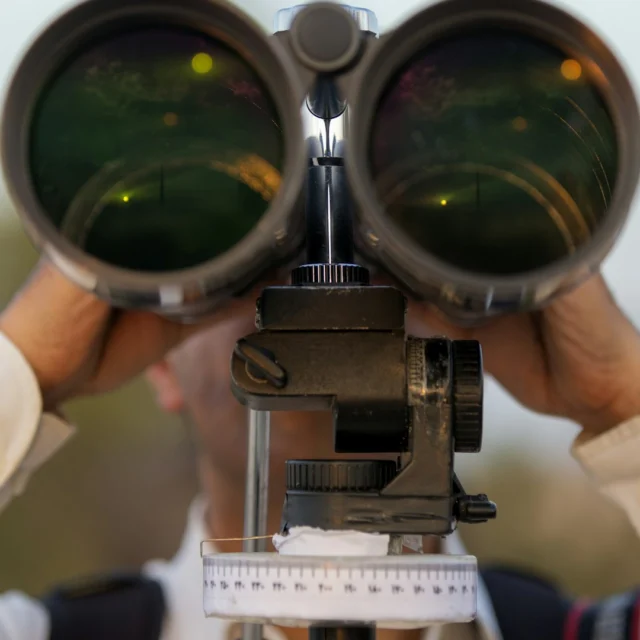
The numbers to remember
- Exit pupils are almost the same: 5 mm for 10x50, about 4.7 mm for 15x70.
- A 70 mm lens collects about 1.96 times the light of a 50 mm lens.
- The Celestron 10x50s compared here show 5.6 to 6.8 degrees of sky; the 15x70s show 4.4 to 4.7.
- The Celestron 15x70s compared here weigh 48 to 51 ounces, the 10x50s 26 to 37 ounces.
- Nikon recommends up to 12x for comfortable handling by general users.
- Neither shows Saturn's rings clearly; 15x may show the planet slightly elongated.
In this guide
15×70 binoculars collect about twice as much light as 10x50s and magnify 1.5 times more, so they show fainter stars, more of each cluster and a bigger, more detailed Moon. The price is weight and steadiness. Typical 15x70s weigh about 3 pounds and are hard to hold still at 15x, so most owners put them on a tripod. 10x50s weigh about half to two thirds as much, show a wider patch of sky and work well handheld.
For a first pair of astronomy binoculars, a 10×50 is the safer choice, because you will use it more often. A 15×70 makes sense as a second pair, or as a first pair if you already own a tripod and plan to observe from a chair or a fixed spot.
What the numbers mean
The first number is magnification, the second the diameter of each front lens in millimeters. Everything else follows from those two figures, using the same formulas as for telescopes.
| Measure | 10×50 | 15×70 |
|---|---|---|
| Magnification | 10x | 15x |
| Exit pupil (lens size / magnification) | 5.0 mm | 4.7 mm |
| Light collected vs a 7 mm eye pupil | about 51x | about 100x |
| Light collected, 15×70 vs 10×50 | 1x | 1.96x |
| Faint-star gain over 10×50 | none | about 0.7 magnitude |
| True field, Celestron models | 5.6 to 6.8 degrees | 4.4 to 4.7 degrees |
| Weight, Celestron models | 26 to 37 ounces | 48 to 51 ounces |
The exit pupils are nearly identical, so the image looks about equally bright per unit of sky in both. The 15×70 wins by spreading that brightness over a bigger image: more magnification with no loss of brightness is why stars look more numerous and clusters more resolved. For more on why exit pupil matters, see the exit pupil guide.
The field figures matter more than they look. A 6 degree field covers about 1.8 times the sky area of a 4.5 degree field. That makes 10x50s easier for finding things and for sweeping the Milky Way. The full Moon is about half a degree wide, so both show it with plenty of sky around it.
Specs of real 10×50 and 15×70 binoculars
The table uses Celestron’s own specification pages and US store prices, checked in November 2026. Celestron’s store marked the Cavalry and Ultima pairs as discontinued at that time, so their prices are the last listed ones and stock may be limited. Other makers’ pairs land in similar ranges, but fields and weights vary by model, so compare the spec sheet rather than the label.
| Model | True field | Exit pupil | Eye relief | Weight | Price as of 2026 |
|---|---|---|---|---|---|
| Celestron UpClose G2 10×50 | 6.8 degrees | 5 mm | 12 mm | 27 oz | $51.95 |
| Celestron Cavalry 10×50 | 5.6 degrees | 5 mm | 19.5 mm | 36.5 oz | $94.95 (discontinued) |
| Celestron Ultima 10×50 | 6.0 degrees | 5 mm | 18 mm | 26.1 oz | $149.95 (discontinued) |
| Celestron Nature DX 10×50 (roof prism) | 5.8 degrees | 5 mm | 17.5 mm | 28.4 oz | $199.95 |
| Celestron SkyMaster 15×70 | 4.4 degrees | 4.7 mm | 18 mm | 48 oz | $129.95 |
| Celestron Cavalry 15×70 | 4.7 degrees | 4.6 mm | 18 mm | 48.7 oz | $129.95 (discontinued) |
| Celestron SkyMaster Pro 15×70 | 4.4 degrees | 4.6 mm | 17 mm | 51 oz | $279.95 |
Two details in that table are worth reading closely. Eye relief, the distance your eye can sit from the eyepiece, matters if you wear glasses: Celestron describes the 17 mm of its SkyMaster Pro as enough for eyeglass wearers to see the entire field, so the 12 mm on the cheapest pair is tight. Prism glass also differs: the UpClose G2 uses BK-7 prisms, while the Ultima, Cavalry and SkyMaster pairs use BaK-4, which Celestron describes as reflecting more light through to the eye. Celestron lists every model in the table as tripod adaptable.
Handheld vs tripod
This is the deciding question for most buyers. Nikon’s binocular guide recommends magnifications up to 12x for comfortable handling by general users and warns that higher power makes the image shake with hand movement. A 10×50 sits inside that range. A 15×70 sits outside it and is also nearly twice as heavy.
In practice:
- 10×50 handheld works for minutes at a time. Stars jiggle slightly, but you can sweep the sky, find clusters and follow a satellite. Bracing your elbows on your chest or on a car roof steadies it further.
- 15×70 handheld is fine for a quick look at the Moon. For anything faint, the shaking hides as much as the extra magnification reveals, and 3 pounds tires the arms fast.
- 15×70 on a tripod shows its full advantage. Stars become steady points and faint ones pop out. The catch is looking up: a camera tripod puts the eyepieces in an awkward spot for objects high in the sky, so many owners use a tall tripod, a parallelogram mount, or observe from a reclining chair.
A 10×50 on a tripod also shows noticeably more than the same pair handheld. If you already own a sturdy photo tripod, a binocular adapter costs little and helps either size.
What each shows in the sky
| Target | 10×50 | 15×70 |
|---|---|---|
| Moon | Large craters, maria and mountain ranges along the terminator | Noticeably more crater detail, best on a tripod |
| Jupiter | A bright disk with up to four moons in a line | Same, a little larger, moons easier near the planet |
| Saturn | A bright point or slightly oval dot | A small oval with possible “ears”; no separated ring |
| Andromeda Galaxy (M31) | Bright core and an elongated glow | Brighter core, more of the outer glow from a dark site |
| Pleiades (M45) | Fits easily with a wide frame of sky | Fills more of the field, more faint members |
| Orion Nebula (M42) | A misty patch around the stars of the sword | Larger, brighter haze with more shape |
| Globular clusters such as M13 | Fuzzy star-like balls | Larger, brighter fuzzy balls; stars not resolved |
| Milky Way star fields | Excellent; the wider field is an advantage | Very good; more stars, less sky at once |
Some of these come with season and sky conditions. NASA lists the Andromeda Galaxy at magnitude 3.1 and best seen in November, visible to the naked eye from a dark site and even with moderate light pollution. NASA’s Night Sky Network notes that Jupiter’s four largest moons are easily visible through a pair of modest binoculars. For Saturn, NASA’s 2023 viewing guide says binoculars may give a hint of the rings, looking more like ears. That hint is harder in late 2026, when the rings are tipped only about 6 to 9 degrees toward Earth after lying edge-on in March 2025. To see the rings as rings, you need a telescope: the guide to how much magnification you need to see Saturn gives the numbers.
What neither shows is color in nebulae or spiral structure in galaxies. The eye’s night vision does not register faint color, and binocular apertures are too small for the structure. Darker skies make a bigger difference than the step from 50 to 70 mm: on Bortle’s scale, moving from a suburban to a rural sky improves the naked-eye limit by about a full magnitude, against the 0.7 magnitude gained from larger lenses. The Bortle scale guide explains how to rate your own sky.
Why 7×50 or 10×42 may suit some buyers
Two other sizes come up in almost every binocular comparison.
- 7×50. A 7 mm exit pupil and wide fields: Celestron’s Cometron 7×50 shows 6.6 degrees, weighs 27.3 ounces and sold for $47.95 in November 2026. The 7 mm beam is only fully used if your dark-adapted pupils open that wide, and research on pupil size (Winn and colleagues, Investigative Ophthalmology and Visual Science, 1994) found that pupils shrink steadily with age at every light level the study tested, most of all at the dimmest one. Younger observers, sailors, and anyone with an unsteady grip get the most from a 7×50.
- 10×42. The same magnification as a 10×50 in a smaller, lighter body, with a 4.2 mm exit pupil and about 30 percent less light. It is the better daytime and travel binocular and a reasonable choice if one pair must cover birding and stargazing.
Above 15×70 the next common steps are 20×80 and 25×100, which are tripod-only instruments. Celestron’s SkyMaster 25×100 sold for $519.95 in November 2026. At that point, a small telescope is a serious alternative.
Prices as of 2026
On Celestron’s store in November 2026, 10x50s still on sale ran from $51.95 for the UpClose G2 to $439.95 for the TrailSeeker ED, and porro prism 10x50s from the major makers typically cost about $50 to $150. Porro 15x70s ran from $129.95 for the SkyMaster to $349.95 for the SkyMaster Pro ED, which weighs 73.7 ounces. Budget porro pairs from the major makers are usually fine for stargazing; spending more mainly buys sharper edges of the field, better coatings, waterproofing and tighter quality control.
Whatever you buy, check one thing in the first week: point the binoculars at a bright star and see whether the two images merge into one. If you see two stars that will not merge, or your eyes feel strained after a minute, the two halves may be out of alignment, and an exchange is the easiest fix while the pair is new.
Which to choose
| If you… | Choose |
|---|---|
| Want one pair for handheld stargazing | 10×50 |
| Already own a tripod and observe from home | 15×70 |
| Wear glasses | Either, with about 17 mm of eye relief or more |
| Are buying for a child | 10×50 or a lighter 8×40 |
| Want to sweep the Milky Way and find things easily | 10×50 or 7×50 |
| Want the most stars and cluster detail per dollar | 15×70 on a tripod |
| Need daytime and night use in one pair | 10×42 or 10×50 |
Binoculars are also the best companion to a telescope, not a replacement for one: they find and frame targets that the telescope’s narrow field would make hard to locate. If you are weighing a pair of binoculars against a first telescope, the refractor vs reflector guide covers the telescope side, and the field of view guide shows why binoculars see so much more sky at once.
Questions people ask
Can you see Saturn's rings with 15x70 binoculars?
Not as a separate ring. At 15x, on a tripod and on a steady night, Saturn can look slightly oval or show small bumps on either side, which NASA describes as rings that look more like ears. A telescope at roughly 25x or more shows the ring shape, and 50x to 100x separates it clearly from the planet. In the second half of 2026 the rings are tipped only about 6 to 9 degrees toward Earth, which makes even that hint harder than in years when they are wide open.
Can you hold 15x70 binoculars by hand?
For short looks, yes, but the view shakes. Nikon recommends up to 12x for comfortable handling and viewing by general users, because higher magnification magnifies hand movement too. Celestron's 15x70s weigh 48 to 51 ounces, so arms tire within a minute or two. Leaning on a car roof or a fence post helps. For real observing, a photo tripod with a binocular adapter or a reclining chair with elbow support makes a large difference.
Is 10x42 better than 10x50 for stargazing?
For the night sky, 10x50 has the edge. Both magnify 10 times, but the 50 mm lenses collect about 40 percent more light and give a 5 mm exit pupil instead of 4.2 mm, so stars and clusters look a little brighter. A 10x42 is smaller and lighter, which suits birding, hiking and travel. If one pair must do both daytime and night duty and weight matters, a good 10x42 is a reasonable compromise.
What can you see with 10x50 binoculars?
From a dark site, 10x50s show the Andromeda Galaxy's bright core, the Pleiades and Beehive clusters framed by dark sky, the Orion Nebula as a misty patch, Jupiter with one to four of its large moons, and craters along the Moon's terminator. They also make Milky Way star fields come alive. Most deep-sky objects look like small gray glows rather than the colorful shapes in photographs.
Are 7x50 or 10x50 binoculars better for astronomy?
10x50 suits most stargazers better. The 7x50's 7 mm exit pupil only pays off if your dark-adapted pupils open that wide, and pupils tend to shrink with age. 10x50s show fainter stars because of the higher magnification while keeping a 5 mm exit pupil. 7x50s are steadier by hand and give wider fields, which helps on boats, with a shaky grip, or for sweeping large Milky Way regions.
Keep observing
Read next
25mm vs 10mm Telescope Eyepiece: Which Is Stronger and When to Use Each
The 10mm eyepiece is the stronger one: it gives 2.5 times the magnification of the 25mm in any telescope. In a 1000 mm scope…
Nov 26, 2026 · 7 min
How Much Magnification to See Saturn: Rings, Cassini Division and Moons
Saturn's rings start to show as a shape around 25x to 30x and are clearly separated from the planet at 50x to 100x, which…
Nov 26, 2026 · 7 min
Exit Pupil Explained: Formula, the 7 mm Limit and the Right Size for Each Target
Exit pupil is the diameter of the beam of light that leaves an eyepiece or binocular and enters your eye. Work it out as…
Nov 26, 2026 · 7 min