Telescope Field of View: True vs Apparent Field, Formulas and How Much Sky Fits
By Indrek Eenmaa 7 min read Updated November 26, 2026
The numbers to remember
- True field = 57.3 x eyepiece field stop / telescope focal length (Tele Vue).
- Shortcut: true field is roughly apparent field / magnification.
- The full Moon is about 0.53 degrees across on average.
- Tele Vue: 1.25 inch eyepieces max out at a 27 mm field stop, 2 inch at 46 mm.
- In a 1200 mm scope, no 1.25 inch eyepiece shows more than about 1.3 degrees.
- Wider apparent field gives more sky at the same magnification, not more sky than the barrel allows.
In this guide
A telescope’s field of view is the circle of sky you see through the eyepiece, measured in degrees. To work it out accurately, multiply the eyepiece’s field stop diameter by 57.3 and divide by the telescope’s focal length. The quick version is the eyepiece’s apparent field divided by the magnification. A 25 mm Plossl in a 1200 mm Dobsonian shows about 1 degree of sky, roughly two full Moons side by side.
The field you can get has a hard ceiling. Tele Vue gives the largest possible field stop as 27 mm in a 1.25 inch eyepiece and 46 mm in a 2 inch eyepiece. Once you reach that stop, a longer eyepiece only lowers the magnification; it cannot show more sky. That one limit explains most of what follows.
True field vs apparent field
Two different “fields” appear on eyepiece boxes and spec sheets, and they measure different things:
- Apparent field of view (AFOV) is how wide the lit circle looks to your eye, in degrees. It belongs to the eyepiece alone. Classic Plossls are about 50 degrees, Tele Vue’s Panoptics 68 degrees, Naglers 82 degrees and Ethos 100 degrees. A wide apparent field feels like looking through a big window instead of a porthole.
- True field of view (TFOV) is how much real sky fits inside that circle. It depends on the eyepiece and the telescope. The same eyepiece shows a wide true field in a short telescope and a narrow one in a long telescope.
Magnification connects them: an eyepiece showing a 50 degree apparent field at 50x shows about 1 degree of sky. Higher power, same apparent field, smaller patch of sky. That is why the Moon fills a low-power eyepiece with room to spare but only part of it shows at high power.
The field stop formula and the AFOV shortcut
The field stop is a ring inside the eyepiece barrel that forms the sharp edge of the view. Tele Vue’s formula uses it directly:
True field (degrees) = 57.3 x field stop diameter (mm) / telescope focal length (mm)
The 57.3 converts radians to degrees. The magnification does not appear at all, which is the key insight: the field stop and the telescope’s focal length alone set how much sky you see.
The shortcut, true field = apparent field / magnification, is close for simple eyepieces but drifts for wide-angle designs, because published apparent fields are rounded and many wide eyepieces have some distortion toward the edge. Tele Vue also notes that its Nagler, Ethos, Delos and DeLite eyepieces have internal focal planes, so their published field stops are “effective” values. Use the field stop when the maker gives one and label the AFOV result an approximation. The table compares both for an 8 inch f/5.9 Dobsonian with a 1200 mm focal length, using Tele Vue’s own eyepiece specs:
| Eyepiece (barrel) | Apparent field | Field stop | Magnification | True field, field stop method | True field, AFOV shortcut |
|---|---|---|---|---|---|
| 40 mm Plossl (1.25 in) | 43° | 27 mm | 30x | 1.29° | 1.43° |
| 32 mm Plossl (1.25 in) | 50° | 27 mm | 38x | 1.29° | 1.33° |
| 24 mm Panoptic (1.25 in) | 68° | 27 mm | 50x | 1.29° | 1.36° |
| 25 mm Plossl (1.25 in) | 50° | 21.2 mm | 48x | 1.01° | 1.04° |
| 10 mm Delos (1.25 in) | 72° | 12.7 mm | 120x | 0.61° | 0.60° |
| 8 mm Plossl (1.25 in) | 50° | 6.5 mm | 150x | 0.31° | 0.33° |
| 31 mm Nagler (2 in) | 82° | 42 mm | 39x | 2.01° | 2.12° |
| 41 mm Panoptic (2 in) | 68° | 46 mm | 29x | 2.20° | 2.32° |
The first three rows show the same true field from three very different eyepieces, because all three have a 27 mm field stop. The 40 mm Plossl’s shortcut figure is the furthest off, since its 43 degree apparent field is narrow for its focal length. The eyepiece calculator uses the field stop when one is known and the shortcut otherwise, and draws the result next to the full Moon.
How much sky fits: the Moon, the Pleiades and Andromeda
Knowing an object’s size tells you whether an eyepiece will frame it. NASA’s Moon fact sheet gives the Moon’s mean apparent diameter as 1,896 arcseconds, about 0.53 degrees. It varies a little with distance, so 0.5 degrees is a fine working number. Deep-sky sizes below are from NASA where it states one and from the OpenNGC catalog otherwise.
| Object | Approximate size | Field you need to frame it |
|---|---|---|
| Full Moon | 0.53° | About 0.7° or more |
| Orion Nebula (M42) | 90′ x 60′ (1.5° x 1°) in OpenNGC | About 1.5° for the brightest part with surrounding glow |
| Beehive Cluster (M44) | About 1.8° (108.6′) in OpenNGC | 2° or more |
| Pleiades (M45) | About 2.5° (150′) in OpenNGC, including outer members | 2° or more for the main stars with dark sky around them |
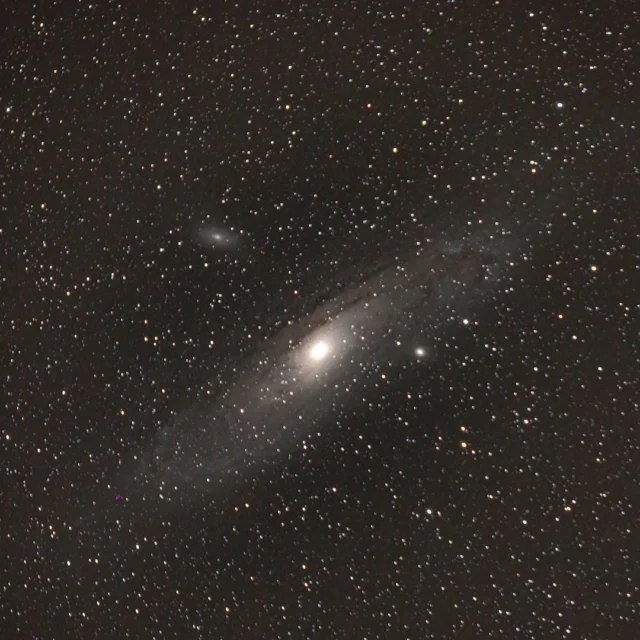
| Andromeda Galaxy (M31) | Six Moon diameters, about 3° (NASA); 178′ x 70′ in OpenNGC | 3° or more; binoculars or a very short telescope |
| Triangulum Galaxy (M33) | 62′ x 37′ in OpenNGC | About 1.2° or more |
Now compare with what telescopes can deliver. The table gives the widest true field each focal length allows, using Tele Vue’s field stop limits:
| Telescope focal length | Typical scope | Widest field, 1.25 inch (27 mm stop) | Widest field, 2 inch (46 mm stop) |
|---|---|---|---|
| 400 mm | Short 70 to 80 mm refractor | 3.9° | 6.6° |
| 650 mm | 130 mm f/5 reflector | 2.4° | 4.1° |
| 1200 mm | 8 inch f/6 or 10 inch f/4.7 Dobsonian | 1.3° | 2.2° |
| 1500 mm | 6 inch f/10 SCT, 12 inch f/4.9 Dobsonian | 1.0° | 1.8° |
So an 8 inch Dobsonian with a 1.25 inch eyepiece cannot show the whole Pleiades or the whole Andromeda Galaxy at once. That is not a defect; it is the trade-off for its long focal length and big mirror. Binoculars, which give fields of several degrees, are often the better tool for the largest objects, as our comparison of 10×50 vs 15×70 binoculars shows. Large, faint objects also need dark skies more than big fields; the Bortle scale guide explains why.
Why the 1.25 inch barrel limits your widest view
A 1.25 inch eyepiece barrel is 31.75 mm wide on the outside. After the walls, there is room for a field stop of about 27 mm and no more, which is the figure Tele Vue gives. Once an eyepiece reaches that stop, making its focal length longer simply lowers the magnification and enlarges the exit pupil while the patch of sky stays the same.
Tele Vue’s own lineup shows this clearly: its 24 mm Panoptic, 32 mm Plossl and 40 mm Plossl all have 27 mm field stops. In any telescope they show identical true fields at 24 mm, 32 mm and 40 mm magnifications. Choosing between them comes down to which magnification and exit pupil you want, plus eye relief and comfort. Celestron’s Omni 32 mm Plossl lists a 27.5 mm field stop, essentially the same limit.
Two practical results follow. First, a 40 mm Plossl in a 1.25 inch focuser shows no more sky than a 32 mm, just a smaller, more porthole-like circle. Second, in a long-focal-length telescope such as an f/10 SCT, the 1.25 inch limit also stops you from reaching a large exit pupil, a point covered in the exit pupil guide.
Wide-field eyepieces and 2 inch focusers
A wider apparent field gives you the same true field at a higher magnification, or a wider true field at the same magnification. Compare two eyepieces at about 50x in a 1200 mm telescope: a 25 mm Plossl (50 degrees) shows about 1.0 degree, a 24 mm Panoptic (68 degrees) shows about 1.3 degrees. The Panoptic gets there because its field stop is larger, right at the 1.25 inch limit.
To go beyond about 1.3 degrees in a 1200 mm scope you need a 2 inch focuser and 2 inch eyepieces, with field stops up to Tele Vue’s 46 mm limit. Many Dobsonians of 8 inches and larger have 2 inch focusers; Celestron’s StarSense Explorer 8 inch, for example, lists a 2 inch Crayford focuser. Small tabletop reflectors and many SCT visual backs take only 1.25 inch eyepieces, so check before you buy.
Wide-field eyepieces cost more, and very fast telescopes (f/4 to f/5) can show stars stretched into seagull shapes at the edge of a wide field. That is the telescope’s coma, not the eyepiece, and it is less visible in simpler 50 degree eyepieces with narrower fields.
How field of view changes at high power
The sky turns: objects drift across a fixed telescope at about 15 degrees per hour near the celestial equator, a quarter of a degree per minute. In the 8 mm Plossl’s 0.31 degree field at 150x, a planet near the equator crosses edge to edge in about 75 seconds. In the 25 mm Plossl’s 1 degree field it takes about 4 minutes.
That is the practical reason wide fields help at high power on manual mounts. An 82 or 100 degree eyepiece at the same power gives you up to twice as long between nudges. On a tracking mount it matters less. Whatever you use, find objects at low power and widest field, center them, and then go up in power. The telescope magnification guide covers how high that next step can usefully go.
Questions people ask
How do you calculate field of view for a telescope?
Use the eyepiece's field stop if the maker publishes it: true field in degrees = 57.3 x field stop (mm) / telescope focal length (mm). Tele Vue gives this formula. Without a field stop, divide the eyepiece's apparent field by the magnification. A 50 degree eyepiece at 50x shows about 1 degree. In Tele Vue's own specs the shortcut lands within a few percent to about 10 percent of the field stop result.
What is the difference between apparent and true field of view?
Apparent field is how wide the circle of light looks to your eye inside the eyepiece, a property of the eyepiece alone, typically 40 to 100 degrees. True field is how much actual sky that circle contains, which depends on the telescope's focal length too. The same 24 mm, 68 degree eyepiece shows over 2 degrees of sky in a 650 mm scope and about 1 degree in a 1500 mm scope.
Which eyepiece gives the widest field of view?
The one with the largest field stop your focuser accepts. Tele Vue says the maximum is 27 mm for 1.25 inch eyepieces and 46 mm for 2 inch. In a 1.25 inch barrel, Tele Vue's 32 mm Plossl, 40 mm Plossl and 24 mm Panoptic all share that 27 mm stop, so they show the same amount of sky at different magnifications. A 2 inch focuser raises the limit by about 70 percent.
Can I see the whole Andromeda Galaxy in a telescope?
Its bright core and inner disk, yes; the full extent, rarely. NASA says the galaxy spans six times the apparent diameter of the full Moon, about 3 degrees. That needs a short focal length and a wide eyepiece, for example a 400 mm refractor with a 1.25 inch eyepiece at its 27 mm field stop limit, or binoculars. In an 8 inch Dobsonian at 1.3 degrees you see the central part.
Keep observing
Read next
25mm vs 10mm Telescope Eyepiece: Which Is Stronger and When to Use Each
The 10mm eyepiece is the stronger one: it gives 2.5 times the magnification of the 25mm in any telescope. In a 1000 mm scope…
Nov 26, 2026 · 7 min
Telescope Magnification Explained: The Formula, Useful Limits and Real Numbers
Telescope magnification equals the telescope's focal length divided by the eyepiece's focal length, so a 1200 mm telescope with a 25 mm eyepiece gives…
Nov 26, 2026 · 9 min
Exit Pupil Explained: Formula, the 7 mm Limit and the Right Size for Each Target
Exit pupil is the diameter of the beam of light that leaves an eyepiece or binocular and enters your eye. Work it out as…
Nov 26, 2026 · 7 min