Exit Pupil Explained: Formula, the 7 mm Limit and the Right Size for Each Target
By Indrek Eenmaa 7 min read Updated November 26, 2026
The numbers to remember
- Exit pupil = aperture / magnification = eyepiece focal length / focal ratio.
- Tele Vue: keep reflector exit pupils between 0.5 mm and 7 mm.
- For binoculars, divide objective size by power: 7x50 gives 7.1 mm, 10x50 gives 5 mm.
- Dark-adapted pupils shrink about 0.4 mm per decade of age in one 2024 study.
- Large exit pupils are brightest; small exit pupils show more detail and fainter stars.
- Below about 0.5 mm, dimness and eye floaters spoil the view.
In this guide
Exit pupil is the width of the beam of light that comes out of an eyepiece or binocular and goes into your eye. You calculate it by dividing the aperture by the magnification, or the eyepiece focal length by the telescope’s focal ratio. A 10×50 binocular has a 5 mm exit pupil; a 25 mm eyepiece in an f/5 telescope gives the same 5 mm.
The number matters because it links three things: how bright the view looks, how much detail you can see, and whether all the light actually fits through your own pupil. Tele Vue advises keeping reflector exit pupils between 0.5 mm and 7 mm. Most good views fall somewhere between 1 mm and 5 mm, depending on the target and on your age.
The exit pupil formula, two ways
Tele Vue’s formula page gives both versions, and they always agree:
- Exit pupil = aperture / magnification. A 203 mm (8 inch) telescope at 100x gives 2.03 mm. For binoculars, this is the only one you need: objective size divided by power.
- Exit pupil = eyepiece focal length / focal ratio. A 20 mm eyepiece in an f/5 telescope gives 4 mm. This version is handy because it ignores aperture entirely: in any f/5 telescope, any 20 mm eyepiece gives a 4 mm exit pupil.
The second form makes eyepiece shopping easy. Multiply the exit pupil you want by your focal ratio and you have the eyepiece focal length. For a 2 mm exit pupil in an f/6 Dobsonian you need a 12 mm eyepiece; in an f/10 Schmidt-Cassegrain you need a 20 mm.
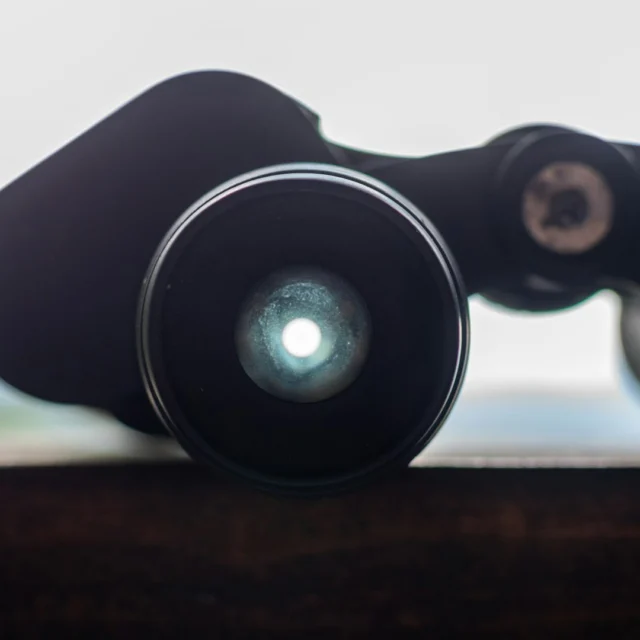
You can also see the exit pupil. Point a telescope or binocular at a bright daytime sky, step back about a foot from the eyepiece, and you will see a small bright disk floating in it. That disk is the exit pupil, and it is where your eye’s own pupil needs to sit. If you can only see a dark eyeball reflection or nothing at all at high power, your eye is missing that tiny disk.
Exit pupils for common eyepieces and telescopes
Focal ratios here are from the makers’ spec pages: Celestron’s AstroMaster 130EQ (f/5), Celestron’s StarSense Explorer 8 inch and Sky-Watcher’s 8 inch Traditional Dobsonian (both f/5.9), and Celestron’s 70 mm PowerSeeker 70EQ and 6 inch NexStar 6SE (both f/10).
| Eyepiece | f/5 (130 mm reflector) | f/5.9 (8 inch Dobsonian) | f/10 (70 mm refractor or 6 inch SCT) |
|---|---|---|---|
| 32 mm | 6.4 mm | 5.4 mm | 3.2 mm |
| 25 mm | 5.0 mm | 4.2 mm | 2.5 mm |
| 20 mm | 4.0 mm | 3.4 mm | 2.0 mm |
| 15 mm | 3.0 mm | 2.5 mm | 1.5 mm |
| 10 mm | 2.0 mm | 1.7 mm | 1.0 mm |
| 6 mm | 1.2 mm | 1.0 mm | 0.6 mm |
| 4 mm | 0.8 mm | 0.7 mm | 0.4 mm |
Two patterns stand out. Fast telescopes (low f-numbers) give large exit pupils with ordinary eyepieces, so they are good at wide, bright views but need short eyepieces for planets. Slow telescopes (f/10 and up) give small exit pupils easily, so a 4 mm eyepiece in an f/10 scope is already below the 0.5 mm floor. The eyepiece calculator shows the exit pupil for every common eyepiece in your own telescope.
Binocular exit pupils
Binocular specs give you the exit pupil directly. Divide the second number by the first:
| Binocular | Exit pupil | Notes |
|---|---|---|
| 7×50 | 7.1 mm | Brightest view, but only if your eye opens that wide |
| 10×50 | 5.0 mm | Common astronomy size, still handholdable |
| 12×60 | 5.0 mm | Same brightness per area as 10×50, more power |
| 10×42 | 4.2 mm | Lighter; a little dimmer per area of sky |
| 15×70 | 4.7 mm | Usually needs a tripod at this power |
| 20×80 | 4.0 mm | Tripod required |
| 25×100 | 4.0 mm | Tripod and a sturdy mount required |
Exit pupil is not the whole story with binoculars. A 15×70 has a slightly smaller exit pupil than a 10×50 but shows fainter stars, because it collects about twice the light and magnifies more, which darkens the sky background. The trade-offs, including weight and whether you can hold them steady, are in our comparison of 10×50 vs 15×70 binoculars.
The 7 mm limit and how pupils shrink with age
The 7 mm figure comes from the widest a young, fully dark-adapted human pupil typically opens. Celestron’s lowest useful magnification of 3.6x per inch of aperture works out to the same number: 25.4 mm divided by 3.6 is about 7 mm. Any light in the beam wider than your pupil lands on your iris and is lost.
Tele Vue pushes back on treating it as a strict rule. With a refractor there is no limit on the useful exit pupil size; you simply waste some aperture. In a reflector, though, the secondary mirror casts a dark shadow in the middle of the exit pupil, and at very large exit pupils that shadow can become big enough to notice. Tele Vue’s example: an 8 inch SCT at 14x has a 6.2 mm shadow, nearly filling a 7 mm eye pupil.
Age is the bigger issue for most people. In a 2024 study in Royal Society Open Science, Lazar and colleagues measured pupils after 10 minutes in darkness and found them shrinking by about 0.4 mm per decade of age. Their fitted line puts the average near 7.3 mm at 20, 6.5 mm at 40, 5.7 mm at 60 and under 5 mm at 80. They also stress large differences between people of the same age, so your own eye may be well above or below the line.
| Age | Approximate dark pupil (fitted average) | Largest exit pupil worth using |
|---|---|---|
| 20 | 7.3 mm | About 7 mm |
| 40 | 6.5 mm | About 6 to 6.5 mm |
| 60 | 5.7 mm | About 5.5 mm |
| 80 | 4.9 mm | About 5 mm |
In practice this means a 60-year-old buying a 7×50 binocular gets roughly the brightness of a 7×40, with the weight of a 7×50. A 10×50 or 10×42 is often the better choice. It also means the longest eyepiece worth owning gets shorter as you age.
Which exit pupil for galaxies, nebulae, the Moon and planets
Makers and retailers publish slightly different ranges, but they agree on the shape: big exit pupils for big, faint things, small exit pupils for small, bright things. These are good starting points:
| Exit pupil | Best for | 8 inch f/5.9 Dob eyepiece |
|---|---|---|
| 5 to 7 mm | Finding objects, the Milky Way, big nebulae like the North America Nebula, nebula filters | 30 to 41 mm (2 inch) |
| 3 to 4 mm | Large clusters, the Andromeda Galaxy, bright nebulae | 18 to 24 mm |
| 2 to 3 mm | Most galaxies, globular clusters, planetary nebulae | 12 to 18 mm |
| 1 to 2 mm | Moon, planets, small planetary nebulae | 6 to 12 mm |
| 0.5 to 1 mm | Close double stars and planets on very steady nights | 3 to 6 mm |
Why not always use the brightest exit pupil for faint objects? Because Tele Vue’s point holds: a 7 mm exit pupil gives the brightest view of a deep-sky object, not necessarily the best. Doubling the power from a 6 mm to a 3 mm exit pupil keeps the object’s surface brightness relative to the sky about the same, but makes the object bigger and the background darker. Small galaxies and planetary nebulae often pop out better that way. Large exit pupils also show more of the sky glow, which is a real cost under suburban skies; the Bortle scale guide covers how much sky brightness changes from site to site.
For the Moon and planets, brightness is not the problem; detail is. Exit pupils near 1 mm match the magnifications where planetary detail appears. Tele Vue’s eyepiece guide adds a practical note here: with exit pupils of about 1 mm or less, you probably will not need eyeglasses at all. The exception is astigmatism: Tele Vue suggests that observers who need glasses to correct it keep them on and choose eyepieces with at least 15 to 20 mm of eye relief.
Why a very small exit pupil looks dim and blurry
As the exit pupil shrinks, the same light is spread over a bigger image, so surface brightness falls with the square of the magnification. At 0.5 mm the image is a small fraction as bright as at 2 mm. At the same point the telescope runs out of resolution: 0.5 mm corresponds to about 50x per inch of aperture, which Tele Vue says is where detail stops growing. Past that, the view only gets larger, dimmer and softer.
Small exit pupils also make floaters obvious. These are bits of debris inside the eye that drift across the view. The National Eye Institute notes floaters are most noticeable when you look at something bright and plain, which describes a planet’s disk at high power quite well. They are usually harmless. The NEI says to see an eye doctor right away if many new floaters appear suddenly, especially with flashes of light or a shadow across your vision, since that can signal a retinal tear.
If high power always looks dim and mushy, the cause may also be the air, not the eyepiece. Our guide to telescope magnification explains how seeing limits power on most nights.
Using exit pupil to plan an eyepiece set
Exit pupil is the easiest way to plan eyepieces because it works the same in any telescope with the same focal ratio. A simple set covers four steps:
- Low power: the largest exit pupil your eye can use, up to about 6 or 7 mm. In an f/5 scope that is a 30 to 35 mm eyepiece. In an f/10 SCT you cannot get there in a 1.25 inch barrel; a 32 mm or 40 mm gives 3.2 to 4 mm, and that is the practical low end.
- Medium power: 2 to 3 mm, for most deep-sky work.
- High power: about 1 mm, for the Moon and planets.
- Optional maximum: 0.6 to 0.7 mm for doubles and the best nights.
Multiply each exit pupil by your focal ratio to get the focal lengths, and check that the longest eyepiece fits your focuser. The kit eyepieces many scopes ship with, typically a 25 mm and a 10 mm, already cover the low and medium steps in an f/5 to f/6 telescope.
Questions people ask
What is a good exit pupil for a telescope?
It depends on the target. Roughly 4 to 7 mm suits wide views of large nebulae and star fields, 2 to 4 mm works for most galaxies and clusters, about 1 to 2 mm suits the Moon and planets, and 0.5 to 1 mm is for splitting close double stars on very steady nights. Guides from retailers and makers draw these boundaries slightly differently, so treat them as starting points.
How do you calculate exit pupil for binoculars?
Divide the objective lens diameter by the magnification. The two numbers are printed on the binocular: 10x50 means 10 power and 50 mm lenses, so the exit pupil is 50 / 10 = 5 mm. A 7x50 gives about 7.1 mm, a 15x70 about 4.7 mm and a 10x42 about 4.2 mm. You can also see it: hold the binocular at arm's length toward a bright sky and measure the small bright disk in each eyepiece.
Is a bigger exit pupil always better?
No. A bigger exit pupil gives a brighter image, but only up to the size your own pupil opens to. If your eye opens to 5 mm, a 7 mm exit pupil wastes the outer ring of light. In a reflector, a large exit pupil also enlarges the shadow of the secondary mirror. Tele Vue notes that higher power with a smaller exit pupil often shows more detail and fainter stars.
What exit pupil is too small?
Tele Vue advises avoiding exit pupils below 0.5 mm in reflectors. At that size the image is dim and soft, and the bright, small beam makes the eye's own floaters very visible. Many telescopes reach this point near 50x per inch of aperture, which is also the point where Tele Vue says detail stops increasing. For planets, 1 mm or a bit less is usually as far as it is worth going.
Does exit pupil change with age?
Your exit pupil does not change, but the pupil it has to fit into does. A 2024 study in Royal Society Open Science found pupils measured after 10 minutes in darkness shrank by about 0.4 mm per decade of age, with large differences between people of the same age. Many older observers get little benefit from exit pupils beyond 5 or 6 mm.
Keep observing
Read next
Telescope Field of View: True vs Apparent Field, Formulas and How Much Sky Fits
A telescope's true field of view is the patch of sky you see, in degrees. The accurate formula is 57.3 times the eyepiece's field…
Nov 26, 2026 · 7 min
25mm vs 10mm Telescope Eyepiece: Which Is Stronger and When to Use Each
The 10mm eyepiece is the stronger one: it gives 2.5 times the magnification of the 25mm in any telescope. In a 1000 mm scope…
Nov 26, 2026 · 7 min
Telescope Magnification Explained: The Formula, Useful Limits and Real Numbers
Telescope magnification equals the telescope's focal length divided by the eyepiece's focal length, so a 1200 mm telescope with a 25 mm eyepiece gives…
Nov 26, 2026 · 9 min